
✨ This article was AI edited. Editorial responsibility: Ivermectin.cat.
Produced with AI. This article was artificially generated. Editorial responsibility: Ivermectin.cat.
Can ivermectin sheep drench be used on goats? Yes, ivermectin 0.08% sheep drench is commonly used off-label (extra-label) in goats under veterinary guidance; however, because caprine hepatic metabolism clears macrocyclic lactones twice as fast as ovine systems, goats require an elevated oral dosage of 0.4 mg/kg (double the standard sheep dose) to prevent treatment failure and anthelmintic resistance.
Caprine parasitology presents unique pharmacological challenges for livestock producers and large-animal veterinarians. Internal nematodes, most notably the barber’s pole worm (Haemonchus contortus), cause severe hemorrhagic anemia, submandibular edema (‘bottle jaw’), and death in pastured goats. Understanding cross-species metabolic differences is critical when utilizing sheep-labeled formulations.
Caprine vs. Ovine Pharmacokinetics: The Fast-Metabolism Factor
Goats are fundamentally browsing animals with higher hepatic metabolic rates and faster ruminal transit times compared to grazing sheep.
| Pharmacokinetic Metric | Sheep (Ovine) Standard | Goat (Caprine) Requirement | Clinical Implication for Goat Producers |
|---|---|---|---|
| Standard Oral Dose | 0.2 mg/kg (200 mcg/kg) | 0.4 mg/kg (400 mcg/kg) — 2x Dose | Under-dosing goats with the sheep rate breeds drug-resistant nematodes |
| Ivermectin 0.08% Drench Volume | 2.5 mL per 10 kg (22 lbs) | 5.0 mL per 10 kg (22 lbs) body weight | Accurate weight measurement on livestock scales is mandatory |
| Hepatic Clearance Half-Life | approx. 36 to 48 hours | approx. 18 to 24 hours | Rapid caprine biliary metabolism shortens therapeutic blood levels |
| Meat Withdrawal Period | 11 days (labeled) | 14 to 21 days (extended extra-label) | Requires extended withholding under veterinary prescription |
| Milk Withdrawal Period | Not approved for lactating dairy ewes | Not approved for commercial dairy goats | Ivermectin residues concentrate in high-fat caprine milk |
Target Parasites in Caprine Herds
Ivermectin sheep drench provides broad-spectrum efficacy against major gastrointestinal and respiratory nematodes affecting goats:
- Haemonchus contortus (Barber’s Pole Worm): Voracious blood-sucking abomasal nematode causing severe anemia, lethargy, and sudden mortality in warm, humid climates.
- Teladorsagia circumcincta (Brown Stomach Worm): Causes chronic unthriftiness, watery diarrhea, and poor weight gain in young growing kids.
- Trichostrongylus colubriformis (Black Scour Worm): Heavy burdens cause severe dark, foul-smelling scours and weight loss.
- Dictyocaulus filaria (Large Lungworm): Triggers chronic coughing, bronchitis, and secondary bacterial pneumonia.
- Nasal Bots (Oestrus ovis): Larval instars inhabiting the nasal passages causing chronic catarrhal discharge and head shaking.
Correct Oral Administration Methodology for Goats
To ensure optimal anthelmintic absorption and bypass the rumen esophageal groove reflex, follow standard caprine drenching technique:
- Accurate Body Weight Assessment: Weigh goats individually using a livestock scale or weight tape. Never estimate by eye, as under-dosing is the leading driver of super-strain parasite resistance.
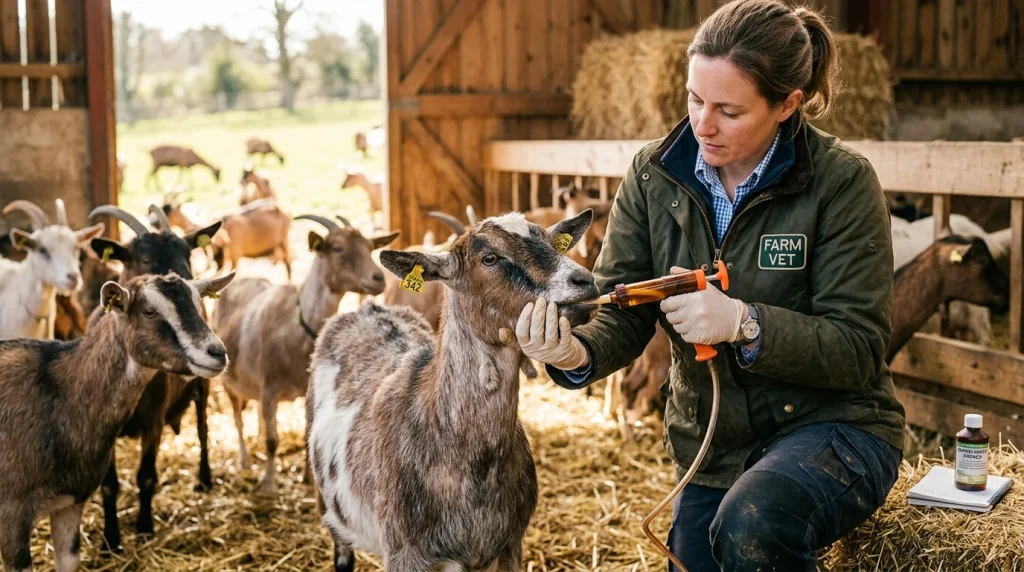
- Position Drenching Nozzle Over the Tongue: Insert the drench gun nozzle into the corner of the goat’s mouth and place the tip over the base of the tongue. Administering liquid into the front of the mouth causes the goat to spit out medication or triggers the reticular groove reflex, dumping the drug directly into the abomasum where it is rapidly eliminated.
- Hold Head in Natural Level Position: Keep the goat’s head level horizontally. Do not elevate the nose excessively high, as this increases the danger of liquid entering the larynx and causing aspiration pneumonia.
- Post-Treatment Fecal Egg Count Reduction Test (FECRT): Collect fecal samples before and 10 to 14 days after drenching to calculate the percentage reduction in strongyle eggs, verifying that the worm population remains susceptible to ivermectin.
Refugia Management & The FAMACHA Diagnostic System
Mass prophylactic herd deworming is strongly discouraged by modern veterinary parasitologists. To preserve drug efficacy and maintain ‘refugia’ (a population of unselected, susceptible parasites on pasture), producers utilize targeted selective treatment (TST):
- FAMACHA Scoring: Evaluate the color of the lower eyelid conjunctival mucous membrane on a 1-to-5 scale (1 = Optimal red, 5 = Severe white anemia). Treat only goats scoring 4 or 5 (or 3 in pregnant/nursing does).
- Body Condition Scoring (BCS): Monitor herd members for hollow flanks, muscle wasting along the spine, and dull coats.
- Pasture Rotation & High-Tannin Forage: Graze goats on tall forages (above 10 cm / 4 inches) and establish sericea lespedeza or birdsfoot trefoil pastures, which possess natural condensed tannins that suppress parasite egg hatching.
Frequently Asked Questions (FAQ)
Can I give ivermectin pour-on cattle drench orally to goats?
No. Pour-on cattle formulations contain harsh chemical solvents (such as isopropyl alcohol and mineral spirits) designed solely for transdermal penetration through thick cattle hides. Oral ingestion causes severe chemical ulceration of the goat’s oral mucosa and abomasum.
Can ivermectin sheep drench be given to pregnant does?
Ivermectin 0.08% sheep drench is generally considered safe during the second and third trimesters of caprine pregnancy. However, caution is advised during early organogenesis (the first 30 days post-breeding).
What should I do if ivermectin fails to clear worms in my goats?
Consult your veterinarian immediately. When resistance to macrocyclic lactones develops, veterinarians rotate to a combination therapy combining multiple anthelmintic classes (such as levamisole plus albendazole or moxidectin).
Is there a milk withdrawal time for dairy goats given sheep drench?
Yes. Ivermectin is highly lipophilic and partitions heavily into butterfat. While labeled sheep drench has no official dairy approval, extra-label veterinary withdrawal periods range from 28 to 35 days for milk consumption.
Recibe nuestras últimas guías, noticias y análisis destacados en la Búsqueda de Google y en AI Overviews.